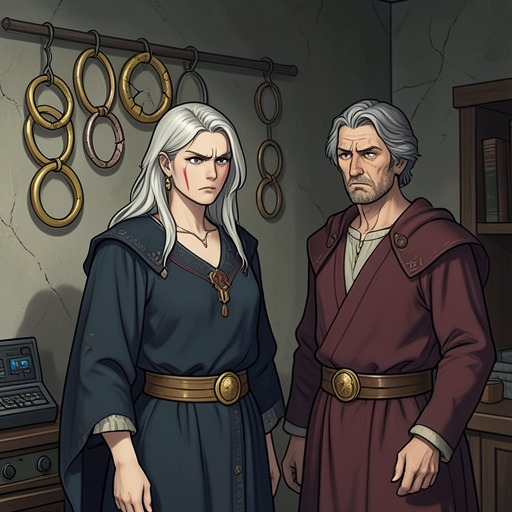
Apprenticeship Status
New Life as a Max Level ArchmageApprenticeship Status is a Grand System experience-boosting rule that formalizes the relationship between a powerful master and a lower-level apprentice. It does more than recognize instruction: when the conditions are met, it grants the apprentice a buff whose strength grows with the gap between teacher and student, turning mentorship into a measurable route for accelerated advancement and the continuation of a master’s legacy.
Definition and Operation
When someone of a higher level takes on an apprentice whose level is lower and whose class is sufficiently similar to the master’s, the apprentice receives Apprenticeship Status. Saffra explains that the effect is stronger when the difference between master and apprentice is greater, so the system rewards precisely the imbalance that makes instruction valuable: the master possesses knowledge and power that the student has not yet acquired. The status is therefore both relational and mechanical, arising from an apprenticeship rather than from equipment, a temporary spell, or ordinary companionship.
The rule has broader implications than a simple experience multiplier. Vivi recognizes that it allows a high-level person to pass down a legacy, preserving specialized knowledge across generations instead of forcing every practitioner to advance in isolation. The system consequently embeds social structure into progression. Apprenticeship can transmit spells, techniques, habits of thought, and access to a powerful teacher, while the Grand System translates that bond into faster growth. Saffra regards the arrangement less generously, observing that even an incompetent person might race through the levels if backed by a wealthy family. Her criticism identifies the rule’s central inequality: advancement remains partly dependent on who can secure a powerful master and the resources surrounding that relationship.
Relation to Training and Instruction
For Saffra, the future benefit of Apprenticeship Status is not the only reason to seek Vivi’s guidance. The status may take days to manifest, whereas the immediate value of an experienced mage is practical instruction: learning new spells, refining existing ones, and understanding how to control mana more precisely. Saffra has been hoping for an elementalist class evolution and relies mainly on fire and ice magic, using Flame Bolt and Ice Spear as common attacks, Fireball when she has time to channel, Arcane Shield for defense, and Frostbind or Ice Slick for disruption. Her grimoire contains thirty-three recognized spells, though most are low-tier, making Vivi’s expertise valuable even before the system grants its formal reward.
Vivi treats the mechanic as an intellectual discovery as well as a benefit to Saffra. She sees that the status may let a high-level mage preserve and distribute a legacy, but she does not reduce apprenticeship to an abstract rule. She promises to set aside time to help Saffra and, if necessary, arrange other lessons through her contacts. That promise matters because the system’s buff cannot substitute for teaching: it accelerates experience, while the master must still supply judgment, technique, and access to better methods.
Boundaries on Experience Gain
Apprenticeship Status does not erase the apprentice’s need to act. Saffra explains that summons, pets, and similar external forces provide experience only when they originate from the recipient’s class. Strong equipment can assist with survival, but the person seeking levels must still do most of the work. Vivi therefore concludes that the principal shortcuts available to advancement are Apprenticeship Status and the best equipment suited to the situation, not the passive abuse of artifacts or borrowed power.
The rule also distinguishes supervision from active participation. Vivi has repeatedly recast shields on Saffra out of habit, but she realizes that the System will not treat Saffra’s efforts as solo work if Vivi’s active magic is affecting the fight. Merely watching over Saffra and remaining ready to intervene does not appear to damage her progress; active spells do, because Vivi’s much greater power would make her responsible for the combat and award her the credit. The distinction gives Apprenticeship Status a technical boundary: the master may guide and protect, but cannot freely perform the apprentice’s battles without undermining the experience the apprentice is meant to earn.
Demonstrated Effect on Saffra
The most dramatic evidence of Apprenticeship Status appears during an hour-long hunting expedition. Saffra begins at level 385 and gains fourteen levels while hunting, a result far beyond what she had imagined possible. She casts dozens of Scorchlances and kills three-quarters of her targets instantly; when she misses or the spell fizzles, Vivi intervenes to save her. Saffra kills twenty-five monsters, but her apprenticeship status makes the experience equivalent to that of two hundred and fifty kills, causing an extraordinary burst of advancement.
The increase does not operate as a perfectly predictable formula. Saffra does not gain two levels from every kill, and she understands that levels depend on feats as well as effort. Her initial leap seems connected to the Grand System recognizing the achievement of killing a monster one hundred levels higher, while the apprenticeship effect magnifies the experience earned through the later hunt. The result is therefore a combination of exceptional accomplishment, sustained participation, and the status’s multiplier rather than a guaranteed payment for every defeated enemy.
Saffra’s response is divided. She is astonished by the speed of her progress, having never imagined fourteen levels in one hour, but the advantage also makes her angry because it feels unfair. She believes levels should go to those who work hardest, while acknowledging that talent already makes the world unequal. Apprenticeship Status turns that inequality into a visible system rule: even when Saffra herself is the one performing the work, her access to a vastly stronger mentor changes the scale of the reward.
Narrative and Social Significance
Within the story, Apprenticeship Status connects intimate mentorship to the wider hierarchy of wealth, level, class, and inherited opportunity. Vivi’s desire to help Saffra, including arranging circumstances in which Saffra can claim a meaningful victory, is not merely kindness; it creates the conditions for Saffra to grow under a master whose level gap can produce an unusually strong buff. The rule thus gives mechanical weight to Vivi and Saffra’s developing master-apprentice bond.
Its social consequences extend beyond their relationship. Noble families already use heirloom equipment and apprenticeship bonuses to accelerate the development of their heirs, so the rule helps explain how privilege reproduces itself through both possessions and instruction. At the same time, it offers a constructive form of continuity: a powerful practitioner can pass knowledge onward rather than allowing a hard-won legacy to disappear. Apprenticeship Status is consequently neither simply benevolent nor simply corrupt. It can reward care, teaching, and genuine effort, yet it can also convert family wealth and access to high-level mentors into rapid advancement, making the Grand System’s promise of measurable progress inseparable from the unequal society in which that progress occurs.